The Importance Of Data Collection For The Six Sigma DMAIC Approach
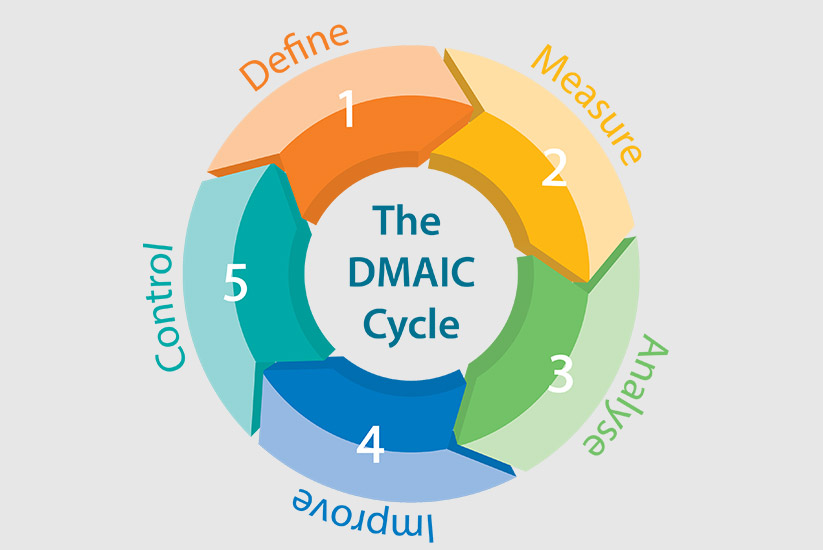
Six Sigma aims at achieving innovative improvement by reducing variation and defects; the most popularly used approach being the DMAIC model. DMAIC stands for Define – Measure – Analyze – Improve – Control.
- Define – This involves identifying the problem, opportunity for improvement, goals, and customer requirements.
- Measure – This involves measuring the performance of the process.
- Analyze – This involves evaluating the process to determine the root causes of variation and defects.
- Improve – This involves improving the process performance by eliminating those root causes.
- Control – This involves controlling and maintaining the improved process.
Although all the five stages of the DMAIC model are important, and neither one can be performed without the other, today we will speak about the Measure phase, which is the lengthiest phase of the model.
The Measure phase includes data collection, wherein different types of data are collected and then forwarded for analysis and identification of possible root causes. Therefore, the understanding of various data types in very important. There are basically two types of data you must know about – discrete and continuous.
Discrete data
Discrete data is that which cannot be further broken down, and has a finite number of measurements that are based on counts. This type of data can be divided into three basic types.
- Ordinal data – This is the data that can be put in an order, like 1st, 2nd, 3rd, etc.
- Nominal data – This is the descriptive type of data that is not numeric, like names, colours, phone numbers, etc.
- Binary data – This is the qualitative or categorical data that is made up of two classifications, like yes-no, on-off, good-bad, pass-fail, etc.
Continuous data
Continuous data is that which can be broken down further. This includes time, temperature, weight, height, money, etc. For example,
- Time can be broken into hours, minutes, and seconds
- Temperature can be broken into Degrees, Celsius, and Fahrenheit
- Weight can be broken into kilograms, grams, etc.
- Height can be broken into feet, inches, and fractions
- Money can be broken into Rupees, Dollars, Yens, Euros, etc.
Let us now compare both these data types. Discrete data is less precise, less informative, less time-consuming, and cannot remove estimations. Continuous data, on the other hand, is more precise, more informative, more time-consuming, and can remove estimations and rounding of measurements.
How is data collected?
As we know that data collection is an important aspect of the Measure phase of the DMAIC model, the question is that how is this data collected. A data collection plan (DCP) is implemented to capture in a single place different data points required for the project. In this way, all the members involved in the project are brought together on the same page. A DCP involves the following –
- The measurements that need to be recorded
- The process through which the measurement is calculated
- The kind of measurement metric that needs to be used in the process
- The mention of whether the data is discrete or continuous
- The mention of the type of sampling methodology used to collect data
- The frequency at which the data needs to be collected
- The person/machinery responsible to collect the data
Six Sigma carries many more important aspects and tools. For complete knowledge about the Six Sigma principles, functioning, and benefits, you need to opt for training that can help you achieve a professional Six Sigma certification in India from experts like TQMI.

Comments
Post a Comment